
Industry Insights & Guides
Safety Net Fixings & Anchor Points: What Holds the Net Up
A net is only as strong as its fixings. Border ropes, lashings, anchor spacing and inspection — what to specify so the net stays up when it is needed.
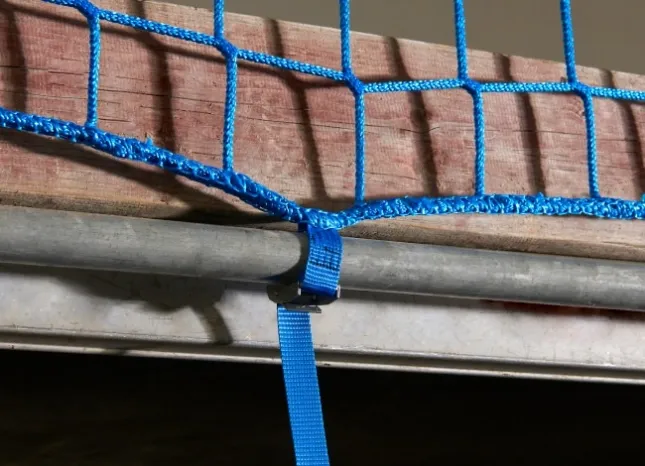
A buyer who compares two safety nets usually compares mesh, material and class. Almost nobody compares the fixings — and the fixings are what decide whether the net is still there when something falls into it. A net rated to catch a fall is only as strong as the rope around its edge, the ties that hold that rope, and the points those ties are fixed to. If any one of those three fails, the net does not catch: it tears free, sags open, or pulls its anchors out of the structure. Specify the fixing system with the same care as the net itself, and check it before anyone works above it.
1. The fixing system is part of the net, not an accessory
A safety net is not a piece of mesh. It is a system: the mesh, the border rope sewn or laced around its edge, the lashings or ties that connect the border rope to the structure, and the anchor points on the structure itself. Each part carries the load in turn — a falling person loads the mesh, the mesh loads the border rope, the border rope loads the ties, and the ties load the anchors. A weak link anywhere in that chain is a weak net, whatever the label on the mesh says. When you order a net, ask what fixings come with it. A quote that lists the net but not its fixings is an incomplete quote, and the missing fixings are usually improvised on site — which is where most fixing failures start. The label guide explains how to read the class and system on the net itself; this guide covers everything the label does not say.
2. The border rope carries the load
The border rope is the backbone of the net. When a fall loads the mesh, the force gathers at the edge, and the border rope spreads it along the perimeter to the ties. A net without a sound border rope cannot hold its shape, let alone a fall: the mesh pulls out of line, gaps open at the edge, and the load concentrates on a few meshes instead of spreading across the whole net. Under OSHA 1926.502, the border rope of a personnel net must have a minimum breaking strength of 5,000 pounds. Check the rope before the net goes up and every week after: cuts, fraying, flattened or melted spots, and any place where the rope has pulled away from the mesh are all reasons to take the net out of service. A border rope that has been dragged across concrete or left pinched under a scaffold board is not a border rope any more. The inspection guide covers the weekly checks and the retirement decision in full.
3. Lashings and ties: every fixing point, no gaps
The ties connect the border rope to the anchors, and they are the most skipped part of the whole system. Every fixing point the installation plan calls for must be tied — not every second one, not the convenient ones. A missing tie is not a small gap: it leaves a length of border rope unsupported, and under load that length bows out, opening a hole at the very edge where a falling person or object is most likely to reach. Use the tie the manufacturer specifies — rope, strap or cable tie of the specified strength — and tie it the way the instructions show. Wire that cuts into the border rope, frayed cord reused from the last job, and ties pulled tight enough to crush the mesh are all failures waiting for a load. Count the ties at handover: if the plan calls for a tie at every fixing point, the count on the net should match the plan, and any tie that is loose, cut or missing should be fixed before work starts above the net. The installation guide covers the fixing-point layout; the mesh-size guide explains why the edge of the net is where the load concentrates.
4. Anchor points must be structural — and rated
A tie is only as good as what it is tied to. Anchor points must be part of the structure, or fixed to it in a way that has been checked for the load — not to a guardrail, a handrail, a loose board, or a scaffold tube that was never designed to take it. Under EN 1263-2, anchor points must take not less than 6 kN. Ask what the anchors on this job are fixed to, and whether anyone has checked that fixing for the load: a bracket bolted to sound concrete is an anchor; a rope looped around a scaffold coupler that nobody has checked is a guess. On a finished or historic facade, drilling into the structure may not be allowed at all, and the anchors must be designed around that — the bridge guide covers the no-drilling case, and the high-rise guide covers brackets and gallows-type supports on a rising frame. Never let an installer pick an anchor point by convenience. The point that is easiest to reach is rarely the point that has been checked.
5. Spacing and sag: gaps open where ties are wide apart
Fixing points are spaced for a reason. Too wide apart, and the net sags between them; the sag is not cosmetic — it is a gap that a falling object can pass through, and it changes the catching width the net was designed for. EN 1263-2 sets the fall height, the catching width and the fixing-point loads together: the net must reach out far enough to catch the fall, and it can only do that if the fixings hold it in position. Follow the spacing in the installation plan for this net, at this span, on this structure — not a spacing remembered from another job. If the structure forces a wider span than the plan allows, that is a design question to settle before the net goes up, not a problem to solve by leaving a tie out. The installation guide covers fall height and catching width; the combined-systems guide shows how a debris liner changes the load the fixings must carry.
6. Check the fixings before handover — then every week
No net should be worked above until its fixings have been checked. Walk the whole perimeter before handover: every tie present and tight, every anchor point sound, the border rope continuous and undamaged, the net tensioned without sagging gaps, and the test mesh reachable for its annual test. Then check again every week, and after any high wind, any impact, and any time the net has been moved or re-tensioned. Fixings loosen: ropes stretch, ties slip, scaffold moves under load, and a net that was tight on Monday can be slack by Friday. A weekly check that finds a loose tie is a repair; a fall that finds it is an accident. The OSHA checklist gives the full pre-use check; the inspection guide gives the weekly routine and the signs that mean retiring the net.
7. The mistakes that undo a good net
Most fixing failures are not bad luck. They are the same few mistakes: ties skipped to save time, anchors chosen for convenience instead of strength, border rope dragged, pinched or cut during handling, old lashings reused until they fray, and hardware mixed from different systems that was never meant to work together. Another is fixing the net to a scaffold that nobody has checked for the extra load — a full wrap of netting is a sail, and the wind load goes into the scaffold and its fixings, not just into the net. The high-rise guide covers the wind case floor by floor. None of these mistakes shows on the label, and none of them is fixed by buying a stronger net. A strong net on weak fixings is a weak system, and the only way to know is to check the fixings the same way you check the net.
8. Six questions to ask your supplier
Before you order, get these answers in writing: what fixings are included with the net, and what must be supplied on site; what the border rope is rated to, and how it is attached to the mesh; what tie or lashing is specified, and at what spacing; what the anchor points must be fixed to, and what load they must take; whether the scaffold or structure has been checked for the load the net and its fixings will put on it; and how the fixings should be inspected, how often, and when a tie or rope must be replaced rather than re-tied. Keep the answers with the net's label, so the person who installs the net, the person who inspects it weekly, and the person who tests it in a year's time are all working from the same specification. The buyer's checklist pulls the same questions together for any safety-net order, and the custom-order guide walks through size, mesh, rope and the factors that affect cost — without inventing a price, MOQ or lead time, because those depend on the order itself.
The net is the system
A safety net does not fail at its strongest point. It fails at its weakest fixing — the tie that was skipped, the anchor that was never checked, the border rope that was cut on a scaffold board and nobody noticed. Specify the fixings with the net, count them at handover, and check them every week. The net is the system, and the system is only as strong as what holds it up.