
Industry Insights & Guides
Safety Net Inspection, Maintenance and Retirement Guide
How to inspect a safety net each week, keep it in service through the job, and know when to retire it — checks, test mesh, drop testing and clear take-out-of-service rules.
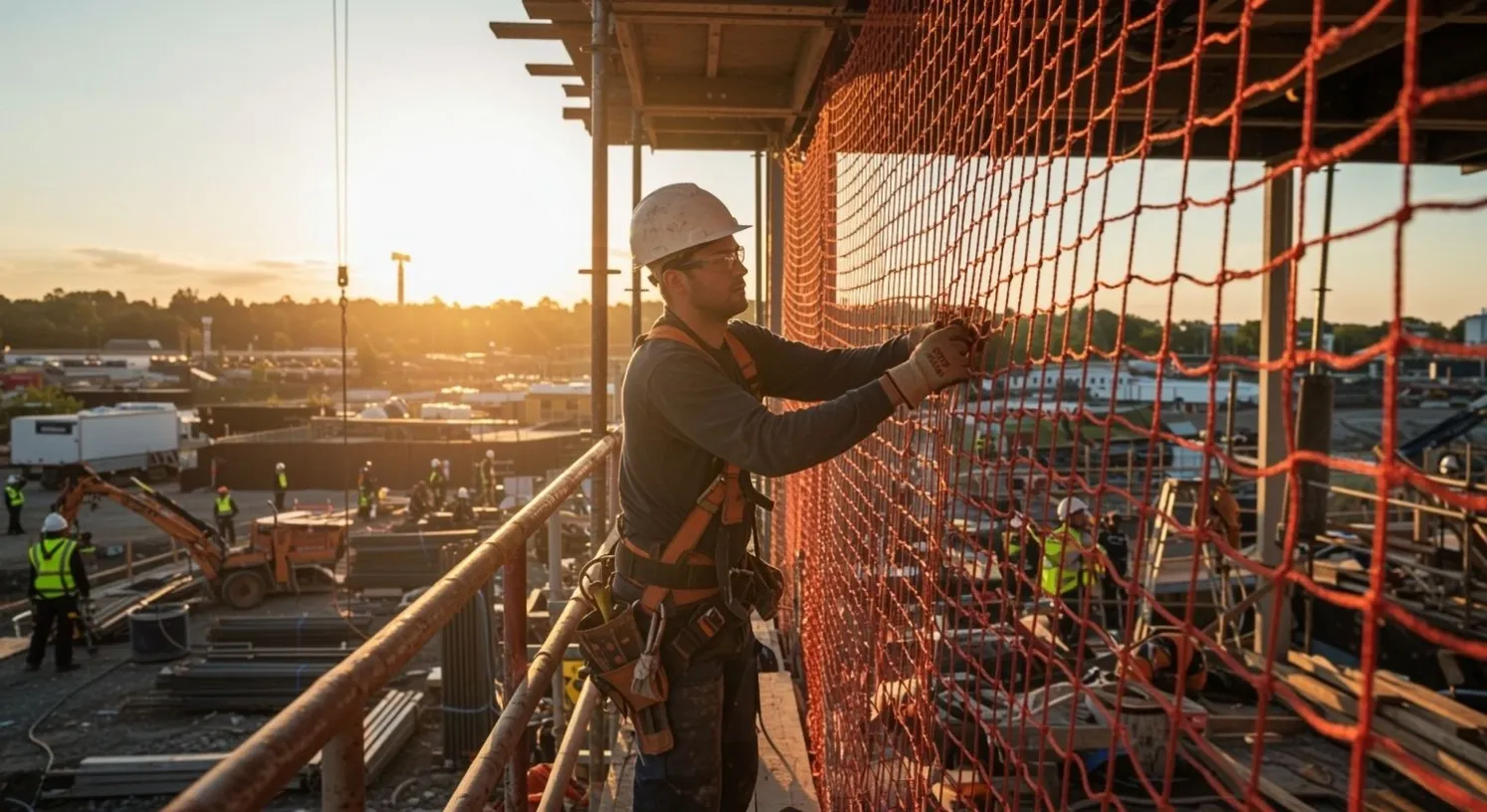
A safety net only protects people if it is still sound on the day it is needed. Nets work outdoors, carry loads, and age in sun, rain and dust — so inspection is not a one-off task at installation. It is a routine, and retirement is a decision with a clear trigger, not a guess.
Inspect every week — and after anything unusual
Under OSHA 1926.502, safety nets must be inspected at least once a week for wear, damage and other deterioration, and after any event that could affect their integrity. Build the weekly check into the site routine and record it. A practical weekly check covers:
- Mesh: look for cuts, broken or unravelling strands, enlarged or distorted openings, and heat or chemical damage. Pay attention to the areas that take the most wear — edges, folds and contact points with the structure.
- Border rope and attachment points: check for fraying, cuts and crushed sections, and that ties, hooks and anchor points are secure and undamaged.
- Knots and joints: on knotted nets, check knots are tight and complete; on knotless nets, check the mesh intersections are intact and have not pulled apart.
- Labels and test mesh: confirm the net's label is present and legible, and that the test mesh specimen supplied with the net is still attached where it can be removed for testing.
- Clearance below: confirm the space beneath the net is still clear and the fall distance still matches the plan — stacked material or a raised work level can quietly remove the clearance a net needs to work.
- Contamination: clear debris, concrete splash, paint and chemicals from the net. Debris left sitting in a net adds load and hides damage underneath.
Inspect again immediately after any fall into the net, a heavy load, a storm, a relocation, or a repair. A net that has caught a fall stays out of service until it has been inspected and, where required, retested.
Drop testing and the test mesh
A visual check cannot prove a net will still arrest a fall. That is what testing is for. Under OSHA 1926.502, nets are drop-tested with a 400 lb sand bag about 30 inches in diameter, dropped from the highest walking or working surface, before first use and after any repair, relocation or change that could affect the net. EN 1263-1 systems use test mesh specimens attached to the net, which are removed and tested periodically so the net itself does not have to be destructively tested. Keep written records of each test: date, net identification, result, and who carried it out. If a net fails a test, it does not go back into service.
Maintenance that keeps a net in service
- Store nets dry and shaded when they are not installed; prolonged sun and damp storage accelerate ageing.
- Do not drag nets across rough ground or over sharp edges, and keep them away from hot work, sparks and chemicals unless the net is rated for that exposure.
- Clean off concrete, mortar and debris rather than letting it harden into the mesh.
- Repair only as the manufacturer instructs. A stitched patch in the wrong place can be weaker than the damage it covers — damage to the border rope or to load-bearing mesh is normally a reason to retire the net, not repair it.
When to retire a net
Take a net out of service immediately — and tag it so it cannot be put back by mistake — when any of these apply:
- It has failed a drop test or a test-mesh result.
- Mesh, border rope or attachment points are cut, broken or badly worn.
- There is visible UV degradation, brittleness, heat damage or chemical attack.
- The label is missing or unreadable, so the net's class and limits can no longer be verified.
- It has caught a fall and has not passed inspection and retesting.
- It has reached the end of the service life or exposure limit the supplier states for that product and environment.
Retirement is not waste: it is the point of the inspection routine. A net retired on schedule is a system working as intended.
What to ask your supplier
Before buying, ask whether test mesh specimens are supplied with the net, what inspection and retirement guidance comes with it, and what exposure limits apply to the material in your conditions. The answers belong in the site's inspection plan, next to the net itself.