
Industry Insights & Guides
UV Resistance in Safety Nets: HDPE, PP and Outdoor Lifespan
Sunlight is the quietest load a safety net carries. It thins the net's strength year by year — and only the annual test-mesh result can say when that has gone too far.
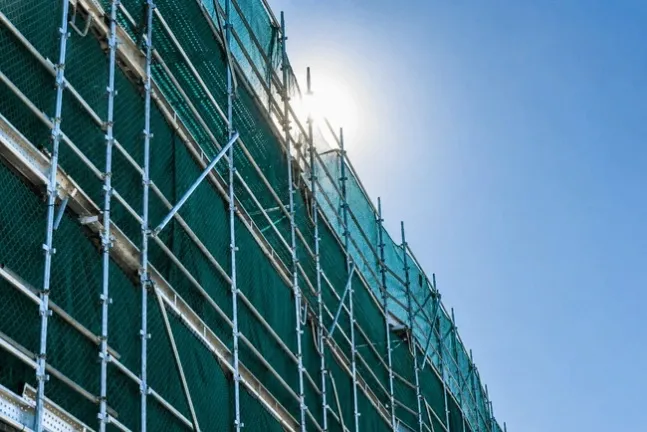
A safety net fails in two ways. The first is sudden: a fall, a dropped tool, a cut rope. The second is quiet, and it is the one buyers forget. Every day the net hangs in the sun, ultraviolet radiation is breaking down the polymer chains in its yarns — a little at a time, with nothing to see at first, until the net that passed its tests when new no longer has the strength to pass them again. Sunlight is the quietest load a safety net carries, and it is the reason no safety net has a fixed service life in years.
What UV actually does to a net
Ultraviolet light drives photo-oxidation. UV photons break the chemical bonds in the plastic, and the damage shows up as discolouration, a chalky white surface, growing brittleness, fine micro-cracks and fraying at cut edges and knots. Chalking is usually the first visible signal — a powder you can rub off the yarn — followed by stiffness and snapping under light load. Heat speeds the process up: degradation accelerates sharply above about 40 °C, which is why a net in a hot, high-UV climate ages far faster than the same net in a cool temperate one.
The mechanism is the same for every plastic net, but the starting point is not. Polypropylene (PP) and low-density polyethylene are the most vulnerable to sunlight; high-density polyethylene (HDPE) degrades more slowly. Nylon (polyamide) is a different case again: unprotected nylon can turn brittle within months in strong sun, which is why outdoor nylon is normally carbon-black stabilised. None of this is a reason to pick a material by reputation alone — it is a reason to ask what stabiliser package is actually in the yarn, because no unprotected polyolefin survives long outdoors.
EN 1263-1 itself is written around polypropylene and polyamide fibres, and it requires the mechanical properties of the materials used in the nets not to decrease significantly between −10 °C and +40 °C. That temperature band is a clue to how the standard thinks about ageing: it is not a promise that a net lasts a set number of years, it is a requirement that the material hold its properties across the conditions a site actually sees.
How UV protection is built in
Protection is compounded into the resin before the net is made, not painted on afterwards. The usual package has three parts, and a buyer can ask about each of them:
- Carbon black — the workhorse. At about 2–3% by weight, finely dispersed through the polymer, it absorbs UV across the 290–400 nm range and turns it into heat before it can reach the polymer chains. It is also why many outdoor nets are black or dark green: the colour is the protection, not a fashion choice. But colour alone proves nothing — a black dye with no carbon black looks the same and protects nothing, so ask for the datasheet, not the colour.
- HALS (hindered amine light stabilisers) — chemicals that scavenge the free radicals photo-oxidation produces, and regenerate as they work. They are often combined with carbon black for a longer service life.
- UV absorbers and antioxidants — absorbers take up UV energy in the resin; antioxidants protect the yarn during processing and against heat ageing in service.
UV exposure itself is measured in KLY (kilolangleys) — the total solar radiation a surface receives over a year, which varies by latitude, altitude and climate. That is why a serious manufacturer expresses UV resistance as a KLY figure rather than a number of years: one maker's datasheet for a high-tenacity polypropylene knotless safety net, for example, states a UV resistance of 300 kLy. Years are a translation of that dose for one climate; move the same net to a sunnier site and the translation changes.
Why there is no fixed number of years
No standard gives a safety net a fixed service life, because the dose is never fixed. Four things decide how fast a net ages, and all four vary from job to job:
- UV dose — latitude, altitude, season and how many hours a day the net is in direct sun. A net on a south-facing facade in the tropics absorbs far more in a year than the same net in northern Europe.
- Temperature — heat accelerates photo-oxidation, so a hot site ages a net faster than a cool one at the same UV level.
- Stabiliser package — the type and amount of carbon black, HALS and absorbers in the yarn, and how evenly they are dispersed. Two nets that look identical can age at very different rates.
- Handling and storage — a net left rigged between jobs, dragged across rough concrete, or stored uncovered in the sun keeps ageing when it is not working. A net taken down, cleaned and stored under cover does not.
That is why lifespan figures quoted for other kinds of netting — shade cloth, bird netting, agricultural mesh — must never be read as safety-net lifespans. A shade net that lasts five to ten years outdoors is not a fall-arrest net, and its number says nothing about whether a safety net will still absorb a fall. For a safety net there is only one clock that counts, and it is not measured in years.
The only clock that counts: the annual test mesh
EN 1263-1 requires every safety net to be supplied with at least one test mesh — a piece of the same netting, from the same production run, loosely threaded through the net and attached in the border area, sealed with the same identity number as the net itself. Under FASET guidance in the UK, a test mesh is removed and tested at intervals of no more than 12 months, in accordance with ISO 1806, to check the net's energy absorption capacity. A new net is normally supplied with three test meshes, so the count of meshes left on the net is a rough indicator of its age: a net made in January should have two meshes left by the following February, one by the February after that.
The result is a pass or a fail, not an opinion. If the test mesh still meets the minimum energy absorption capacity stated by the manufacturer, the net may stay in service for a further period of no more than twelve months. If it falls below that level, the net must be removed from service and destroyed. The test house produces written evidence of the result, which the netting contractor must keep until the following year's results are available — and good practice is to keep the full test history for the life of each net.
That annual test is the answer to UV ageing, and it is the reason visual inspection alone is never enough. A net can look faded and still pass, and a net can look fine and fail — the test mesh is the only part of the net whose job is to be sacrificed so the rest does not have to be guessed at.
Warning signs to watch for
Between annual tests, inspect the net at least weekly while it is in use, before each use, and after adverse weather or any incident. Retire or test early if you see any of these:
- A chalky white surface that rubs off on your hands
- Colour fading well beyond the rest of the net, or patchy fading
- Yarns that feel stiff and snap rather than flex
- Fine micro-cracks, or fraying at cut edges, knots and border ropes
- Knots slipping, or the mesh stretching out of shape
- Any cut, burn, chemical splash or spark damage — UV is not the only ageing agent, and a damaged net does not wait for its test date
None of these signs is a pass/fail test by itself. They are the reason to bring the annual test forward, not a substitute for it.
Storing a net so the sun cannot age it
Most UV damage happens while a net is doing nothing: rigged between phases, or stored in the open. A few habits cost nothing and buy years:
- Take nets down between jobs instead of leaving them rigged in the sun.
- Store rolls and folded nets under cover, out of direct sunlight — if a roll must sit on site, cover it with an opaque, UV-resistant tarpaulin.
- Keep the test meshes attached and the manufacturer's label legible; a net whose test meshes have been cut off cannot be tested, and a net whose identity is lost cannot be traced to its test history.
- Keep the written test history with the net, and note the date of manufacture — the test-mesh count only makes sense against that date.
- Do not try to restore a UV-aged net. No coating or treatment puts broken polymer chains back together, and a net that has failed its test mesh must be destroyed, not repaired and reused.
What to ask your supplier
Before ordering, ask these six questions and keep the answers with the net's label:
- What UV stabiliser package is in this yarn — carbon black content, HALS, UV absorbers — and what accelerated-weathering test backs it (for example ISO 4892 / ASTM G154)? A claim without a test method cannot be compared with anything.
- Is the UV resistance stated as a KLY figure, and for which climate was that figure calculated?
- How many test meshes come with the net, and what is the manufacturer's stated minimum energy absorption capacity that the annual test must meet?
- What is the temperature range the net is rated for, and does it hold its properties across it, as EN 1263-1 requires between −10 °C and +40 °C?
- Is this net polypropylene, polyamide, HDPE or another polymer — and what does that mean for its UV behaviour on this site, in this climate?
- What storage and retirement guidance comes with the net, and who keeps the test-mesh records — the supplier, the installer, or the site?
If a supplier can quote a lifespan in years but cannot show a test report, a KLY figure or a test-mesh programme behind it, the years have been quoted, not measured — and the difference only shows up when the net is tested, or when it is needed.