
Industry Insights & Guides
Bridge, Demolition & Industrial Nets: Where Each Type Fits
A bridge, a demolition site and a warehouse ask three different things of a net. Match the net to the job first — mesh, class and fixings follow from that, not the other way round.
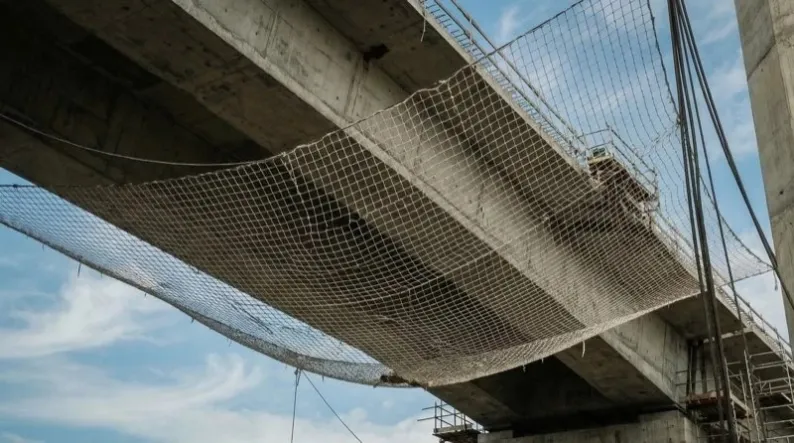
Ask a buyer what a safety net is for and the answer is usually "to catch things that fall". That is true, and it is also where most wrong orders start — because what falls, from how high, onto whom, and over what, changes everything about the net. A net under a bridge, a net wrapped around a demolition scaffold and a net inside a warehouse are three different products that happen to share a name. This guide is about telling them apart before ordering, so the net that arrives is the one the job actually needs.
1. Bridge work: the net is there for what is underneath
On a bridge job the first question is not what falls — it is what is below. A bridge spans a road, a railway, a footpath or a river, and the net's job is to keep everything the work produces — concrete spalls, cut-off ends, fasteners, paint chips, dropped tools — from reaching traffic, pedestrians or water. That makes bridge netting a containment job first and a fall-arrest job second: the net is rigged around or beneath the deck, often as a debris liner sewn inside a coarser personnel-rated net, so that even nails, screws and wood particles are stopped before they can enter a waterway.
Three things make bridge work different from an ordinary scaffold wrap:
- The environment is also the regulation. Over water, environmental rules matter as much as worker-safety rules: on US projects, EPA compliance is often as significant a driver as OSHA compliance, because older bridges can shed paint and materials that must not enter the water. A fine mesh liner is what stops the small stuff — a coarse net alone will not do it.
- The fixing cannot damage the structure. On historic or covered bridges, containment systems are often engineered so nothing is drilled into the structure or permanently fixed to it. That means custom sizing and configuration, not a stock panel — the geometry of a bridge, with its irregular spans and piers, does not match a scaffold bay.
- Clearance is a design constraint. Where traffic must keep passing underneath, the netting is stretched tight beneath the work area so vehicles can pass without damaging the system. A sagging net that dips into the traffic envelope is worse than no net at all.
If the work also puts people at height over the same drop, the personnel net and the debris liner are combined — the coarse net catches the worker, the fine liner catches the debris — as the site's combined-systems guide explains. Order the two together, and say which one is doing which job.
2. Demolition: the net is there for the public
Demolition reverses the usual priorities. The workers are usually on machines or on the ground, and the people at risk are the public: pedestrians on the pavement, traffic on the street, neighbouring buildings. So the net on a demolition job is an encapsulation — fine mesh hung on the outside face of the scaffold, enclosing the building for its full height, so that tools, fasteners, dust and demolition debris stay on the working platforms instead of reaching the street.
What to get right:
- Full-height enclosure, no gaps. Debris netting is placed to enclose all open sides, ends and the bottom of the scaffold — essentially every platform level — and the gaps at corners, at the bottom platform and between rows are where debris gets through. Order the next width up rather than stitching two narrow rolls together; every seam is a place debris can escape.
- A second layer where the risk is higher. Some demolition codes call for an extra layer of heavy-duty net on the scaffold as protection against unexpected falling debris, and a catch-fan projection under strong wind — the Hong Kong Code of Practice for Demolition of Buildings added exactly that after reviewing scaffold failures. If the demolition is heavy, ask whether the job needs that second layer, not whether the first one is "strong enough".
- Fire retardancy where the city requires it. Scaffold netting is often required to be flame retardant to NFPA 701, the standard cities such as New York reference for scaffold netting. The certificate, not the colour or a stripe in the hem, documents compliance — ask for it with the order.
- Wind load on the scaffold. Enclosing a scaffold adds load that the scaffold and its ties have to carry. The qualified person who designed the scaffold and the competent person who inspects it must account for the netting before a full wrap goes up. A wrap added as an afterthought can overload ties that were designed for an open scaffold.
Under OSHA's scaffold standard, 29 CFR 1926.451(h), a debris net is one of the listed ways to protect people below a scaffold from falling tools and materials — alongside toeboards, screens, guardrail systems and catch platforms. It is a containment measure for objects; it is never a substitute for the guardrails and personal fall arrest that protect the workers themselves.
3. Industrial and interior work: the net is there for the space
Inside a building the weather disappears, but the geometry gets harder. The typical industrial jobs are mezzanine and rack edges, conveyor and machinery containment, elevator shafts, atriums and stairwells — places where the fall distance is long and there is no scaffold to hang a wrap from. US guidance treats interior nets as the answer where the workplace is more than 25 feet (7.6 m) above the ground, water or an intermediate floor, and where ladders, scaffolds, catch platforms or safety lines are impractical.
The pattern here is the combination, not the single net:
- Personnel net plus debris liner, together. On interior work the two are used together: the personnel net catches a falling worker, the fine liner catches the tools and materials. Nets are cleaned daily, or as needed, depending on the debris collected — a net full of rubble is a net that cannot catch the next fall properly.
- Overhead protection has its own mesh. Where public traffic or workers must pass underneath a work area, US Army Corps guidance calls for nets lined with wire or synthetic netting of about 3/4 inch (19.1 mm) mesh, so that falling tools and materials are stopped in normal circumstances. The mesh size is chosen for what must be stopped, not for what looks fine enough.
- No UV, different wear. An indoor net does not age in the sun, so the UV-stabiliser package that matters outdoors matters less here. What matters instead is abrasion from forklifts and racking, chemical splash, and repeated handling — and a net that has been dragged across a concrete floor between jobs ages just as surely as one left in the sun. The UV guide's warning applies indoors too: visual inspection alone never proves a net is still good; the annual test mesh does.
- Containment, not just fall arrest. Much industrial netting never catches a person at all: container-door nets that stop goods spilling when a door opens, racking nets that hold pallets in place, conveyor guards. The cargo-nets guide on this site covers the container-door case. These nets are specified by what they must hold back and how it is loaded — a static stack is not a falling body, and the net for one is not the net for the other.
4. What actually changes between the three jobs
| Bridge | Demolition | Industrial / interior |
|---|---|---|---|
Main risk | Debris reaching traffic, water, public below | Debris and dust reaching the street and public | Falls and objects in a long indoor drop |
Net's main job | Containment, often with a fine liner | Full-height encapsulation | Personnel net + debris liner together |
Mesh | Fine liner for small debris and paint chips | Fine mesh for dust and small debris | ~19 mm overhead mesh for tools; liner for small parts |
Standards to name | OSHA + EPA over water; EN 1263-1 systems | OSHA 1926.451(h); NFPA 701 for FR; local demolition codes | OSHA / ANSI A10.11; EN 1263-1 for the personnel net |
Fixing | Engineered, often no drilling into the structure | Scaffold clips, full-height wrap, catch fans | Anchors to structure, atrium/shaft fixings |
Environment | Wind, water, long spans | Wind load on the wrap, dust | Abrasion, chemicals, forklift contact |
The class and system follow the same logic. Under EN 1263-1, System S is a horizontal net with a border rope, System T is attached to brackets, System U is a vertical net fixed to a supporting structure, and System V is a vertical net with a border rope on a gallows-type support — the label guide explains the classes A1/A2/B1/B2. A bridge under-deck net is usually a horizontal System S; a demolition wrap is usually vertical, System U or V; an interior net is usually horizontal, System S, rigged where the floor is missing. If the supplier cannot say which system the net is, the order is not specified yet — whatever the price says.
5. Five mistakes that show up again and again
- Using a debris net as a fall-arrest net. A fine mesh that stops dust is not a net that has been drop-tested to catch a person. The debris-vs-personnel guide explains the difference; a net that does one job well may be wrong for the other.
- Ordering one net for all three jobs. A bridge liner, a demolition wrap and an interior personnel net differ in mesh, class, fixing and test regime. A single "safety net" ordered for all three will be wrong for at least two of them.
- Ignoring wind load. A full wrap on a scaffold or a wide net under a bridge deck catches wind. If the scaffold or the fixings were not designed for it, the net itself becomes the load that fails.
- No test-mesh programme. A net that has been on a bridge or a demolition job, then moved to the next one without its annual test mesh being tested, is an untested net. The test mesh is the only part of the net whose job is to be sacrificed so the rest does not have to be guessed at — the UV guide explains how the annual test works.
- Specifying by price, not by what must be stopped. "Strong net" is not a specification. What falls, from how high, over what, and what must not reach the ground — those four answers are the specification.
6. What to ask your supplier
Before ordering, ask these six questions and keep the answers with the net's label:
- What is this net's job on this site — containment, fall arrest, or both — and which standard and class is it made to for that job?
- Which EN 1263-1 system (S, T, U or V) is it, and how is it fixed — and, for a bridge or historic structure, can it be fixed without drilling into the structure?
- What mesh size, and what is it meant to stop — dust and paint chips, tools and fasteners, or a falling person? What liner, if any, is sewn in?
- Is flame retardancy required for this job or city, and can you supply the NFPA 701 certificate — not just a claim — with the order?
- How many test meshes come with the net, what is the manufacturer's stated minimum energy absorption capacity for the annual test, and how often must it be tested?
- What is the wind load of the installed net, and has the scaffold or the fixing structure been checked for it?
If a supplier can quote a price but cannot answer which system the net is, what it is meant to stop, or how it will be tested, the price has been quoted, not the net — and the difference only shows up when something falls, or when the net is tested.