
Industry Insights & Guides
Safety Net Buyer's Checklist: 10 Questions Before You Order
Ten questions to ask before you order a safety net — job, standard, class, mesh, fixings, test mesh and wind load — each one pointing to the guide that explains it in full.
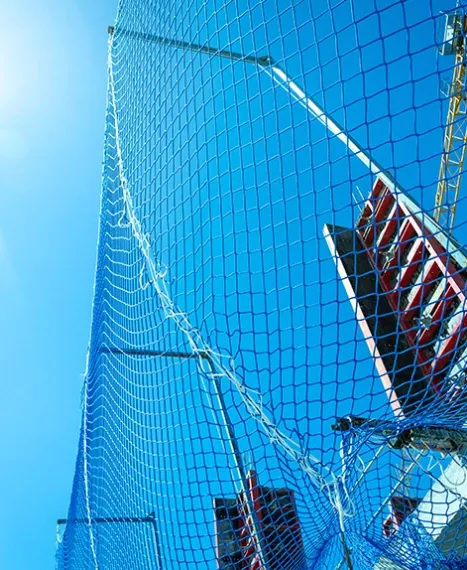
Sixteen guides on this site now cover safety nets from every angle — labels, materials, mesh size, installation, inspection, standards, UV ageing, custom ordering, bridges, demolition and warehouses. A buyer who has read them all still faces the same problem at the end: turning all of that into one order, on one phone call, without forgetting the question that matters. This checklist is that phone call, written down. Ten questions, in the order to ask them. If a supplier can answer all ten, the order is specified. If one goes unanswered, that is the gap to close before paying — not after the net arrives.
- What is this net's job — containment, fall arrest, or both?
Everything else follows from this answer, and it is the question most often skipped. A debris net stops objects; a personnel fall-arrest net catches people; a dual-layer system does both, with a coarse net for the person and a fine liner for the debris. A fine mesh that stops dust is not a net that has been drop-tested to catch a person, and a coarse personnel net on its own will not stop nails, screws and paint chips. Say which job the net is doing, on this site, and order the net for that job — then check the answer against the debris-vs-personnel guide before you go further.
- Which standard applies — and which one is the law where the net will be used?
A US buyer cites ANSI A10.11, a European one EN 1263, and OSHA 1926.502 is the law on US sites. They are three different kinds of document: a standard, a standard, and a regulation — and a pass under one is not a pass under another. Ask the supplier which standard the net is made to, and check that it is the one your site actually has to satisfy. Where the job is over water, environmental rules can matter as much as worker-safety rules. The standards-comparison guide explains which document does what, so the certificate you are shown is the one you actually need.
- Which EN 1263-1 class and system is it — and can the supplier say so?
Under EN 1263-1, classes A1/A2/B1/B2 describe what the net is built to catch, and systems S, T, U and V describe how it is fixed: S is a horizontal net with a border rope, T is attached to brackets, U is a vertical net fixed to a supporting structure, and V is a vertical net with a border rope on a gallows-type support. The class and system should be on the label, and the supplier should be able to name them without looking them up. If a supplier can quote a price but cannot say which system the net is, the price has been quoted, not the net. The label guide explains how to read every part of that label.
- What mesh size — and what is it meant to stop?
Mesh is chosen for what must be stopped, not for what looks fine enough. Fine debris mesh stops dust and small parts; 60 mm or 100 mm fall mesh is the personnel-net range; overhead protection where people pass underneath is commonly lined at about 19 mm (¾ inch) so falling tools are stopped. Ask what the mesh stops — dust and paint chips, tools and fasteners, or a falling person — and whether a liner is sewn in. A single “safety net” ordered without a mesh answer will be wrong for at least one of those jobs. The mesh-size guide gives the full comparison.
- What material — and what does it cost in lifespan, not just in price?
PP, PET, HDPE and nylon differ in strength, UV resistance, water absorption and cost, and the cheapest material on the quote is rarely the cheapest over the net's life. A net that lives outdoors needs a UV-stabiliser package; a net that lives indoors wears instead from abrasion, forklift contact and chemical splash. Ask which material the net is, and why that material fits this job's sun, water and handling — then check the answer against the materials guide and the UV guide, which explains how sunlight thins a net's strength year by year.
- How is it fixed — and has the structure been checked for the load?
A net is only as safe as its installation. EN 1263-2 sets the fall height, catching width and fixing-point loads — the maximum fall height is 6 metres, 3 metres within 2 metres of the edge, and anchor points must take not less than 6 kN — and a full wrap on a scaffold or a wide net under a bridge deck catches wind, so the scaffold or the fixings must be designed for that load. Ask how the net is fixed, what the fixings attach to, and whether the scaffold designer has accounted for the netting before it goes up. On a bridge or historic structure, ask whether it can be fixed without drilling into the structure at all. The installation guide covers fall height and fixing points; the bridge guide covers the no-drilling case.
- What is the clearance below the net — and is it enough?
A net that catches a fall still needs room underneath to do it: the net sags under load, and whatever is below — traffic, plant, a lower floor, water — must be far enough away that the falling person or object never reaches it. Ask for the clearance figure for this net, at this span, and check it against the site below, not against an empty drawing. Where traffic must keep passing underneath, the net is stretched tight beneath the work area so vehicles can pass without damaging the system. The OSHA checklist article lists clearance among the checks that must be made before work starts.
- Is flame retardancy required — and is there a certificate, not just a claim?
Scaffold netting is often required to be flame retardant to NFPA 701 — the standard cities such as New York reference — and EN 13501-1 is the European route to the same question. Ask whether flame retardancy is required for this job or city, and if it is, ask for the certificate with the order. The certificate, not the colour or a stripe in the hem, documents compliance. The flame-retardant guide explains both standards and where FR nets are required.
- How many test meshes come with the net — and when must they be tested?
A test mesh is the only part of the net whose job is to be sacrificed so the rest does not have to be guessed at: it is cut out and tested each year, and its result says whether the net is still good. Ask how many test meshes come with the net, what the manufacturer's stated minimum energy absorption capacity is for the annual test, and how often it must be tested. A net that has been moved from job to job without its annual test mesh being tested is an untested net — and visual inspection alone never proves a net is still good. The inspection guide explains the weekly checks and the retirement decision; the UV guide explains how the annual test works.
- What does the order actually include — sizes, rope, liner, paperwork?
A custom net is only as good as the measurements and specification behind it. Before ordering, confirm the size and how it was measured, the border rope, the liner if any, the fixings, the number of test meshes, and the paperwork that travels with the net: label, standard and class, and any flame-retardancy certificate. Keep the answers with the net's label, so the person who inspects it in a year's time is reading the same specification you ordered. The custom-order guide walks through sizes, mesh, rope and the factors that affect cost — without inventing a price, MOQ or lead time, because those depend on the order itself.
Five red flags — stop and ask again
- “One net does everything.” A bridge liner, a demolition wrap and an interior personnel net differ in mesh, class, fixing and test regime. A single net ordered for all three will be wrong for at least two of them.
- A price with no system, class or mesh. “Strong net” is not a specification. What falls, from how high, over what, and what must not reach the ground — those four answers are the specification.
- A debris net sold as a fall-arrest net. The mesh that stops dust has not necessarily been drop-tested to catch a person. The debris-vs-personnel guide explains the difference.
- No test-mesh programme. No test meshes, no stated test interval, no minimum energy absorption figure — then there is no way to know, a year from now, whether the net is still good.
- A certificate that cannot be produced. A flame-retardancy claim, a standard claim or a test claim without the document behind it is a claim, not a fact. Ask for the document with the order, not after delivery.
Keep this list with the net
Print the ten questions, fill in the answers, and file them with the label. The person who hangs the net, the person who inspects it weekly, and the person who decides in a year whether it retires are rarely the same person — and the answers are the only thing they all share. A net bought on ten answered questions is a specified net. A net bought on a price alone is a guess, and the difference only shows up when something falls, or when the net is tested.